
A documentary on Osaka street food, a half-head of cabbage three days from composting, and a complete absence of professional Japanese grilling credentials produced the okonomiyaki recipe I now make every Friday instead of ordering takeout.
Okonomiyaki translates literally as “grilled as you like it” and describes a savory Japanese cabbage pancake held together by a nagaimo-based batter, topped with a glossy sweet-savory sauce, Kewpie mayo, and dancing bonito flakes. My first attempt landed on the stovetop burner. My second one landed in the pan. Here is exactly how I do it.
reader review
“Crispy Crispy and Crispy. I made this on a Friday night and it tasted exactly like the okonomiyaki I had in Osaka. The two-spatula flip actually worked on my first try and the homemade sauce is so much better than I expected. My whole family stood in the kitchen waiting for the next one to come out of the pan!” – Sandra K.
Loved this too? Add your reviewWhy You’ll Love This Recipe
- Budget dinner by design. Half a head of green cabbage costs under two dollars and produces four large pancakes that feed a table of four. The rest of the ingredients come from a single trip to an Asian grocery store.
- Clears the refrigerator. Leftover pork, random shrimp, that half-onion in the vegetable drawer: every one of those ends up in the batter without anyone noticing it was an accident.
- Freezes and reheats properly. Un-sauced pancakes freeze for up to a month and reheat in the oven without turning rubbery, which makes Sunday batch cooking produce actual weekday lunches worth eating.
- One bowl for the batter. The flour, yam, dashi, eggs, cabbage, and tempura scraps all combine in a single bowl. The pan counts as the second and final piece of equipment to wash.
Tools You’ll Need
- Salad spinner. Wet cabbage releases water into the batter during cooking and turns the entire pancake soggy and loose. Drying the cabbage thoroughly after washing produces a batter that holds its structure through the flip.
- Large nonstick skillet, 12-inch minimum. A wide cooking surface lets the pancake spread into a proper circle with even thickness. A smaller pan forces the batter too thick and the center stays raw while the edges brown.
- Two spatulas. One slides under the pancake for support. The second goes on top to stabilize it during the flip. Attempting this with one spatula produces broken pancake pieces and a smoke alarm situation.
Ingredients
For the Batter and Pancakes
- 1 cup all-purpose flour – The structural glue holding your vegetables together.
- 5.6 oz nagaimo (mountain yam) – This grated root vegetable creates a light pancake instead of a dense hockey puck. Read about Chinese yam if you want the botanical details, but just wear gloves when grating it because it makes your hands itch.
- 3/4 cup dashi – Japanese soup stock gives the batter its savory backbone.
- 1/2 head green cabbage – Finely chopped, not long stringy shreds, or it will not cook evenly.
- 4 large eggs – Binds everything together.
- 1/2 cup tenkasu (tempura scraps) – Adds little pockets of texture inside the pancake.
- 1/2 lb sliced pork belly – Lays on top and crisps up in its own fat while the pancake cooks.
For the Toppings
- Okonomiyaki sauce – You can buy it, or make a quick sauce okonomiyaki recipe using ketchup, Worcestershire, oyster sauce, and sugar.
- Kewpie mayonnaise – The rich, yolk-heavy Japanese mayo that makes this dish worth eating.
- Katsuobushi (bonito flakes) – Paper-thin smoked fish flakes that dance in the steam.
- Aonori (dried green seaweed) – Adds a salty, oceanic finish.
How to Make Japanese Okonomiyaki: Step-by-Step
Do not panic about the flipping part; a slightly ugly pancake tastes exactly the same.
- Mix the base: Combine the flour, grated yam, and dashi in a large bowl. Let it rest in the fridge for an hour if you have the patience, because resting relaxes the gluten and makes it fluffier.
- Prep the cabbage: Chop the cabbage finely and run it through a salad spinner. If you skip drying it, the water leaks out and turns your batter into soup.
- Combine the batter: Add the eggs, tempura scraps, and cabbage to your rested batter. Fold it gently until the cabbage is coated, resisting the urge to overmix.
- Cook the first side: Heat oil in a large skillet over medium heat, pour in a portion of batter, and shape it into a circle. Lay the pork belly slices across the top and cook covered for five minutes so the middle actually cooks through.
- The big flip: Slide one spatula under the pancake, use another on top to stabilize it, and flip it quickly. If it breaks, just shove the pieces back together with your spatula and pretend nothing happened.
- Finish cooking: Cook covered for another five minutes, then uncover for two minutes to crisp the edges.
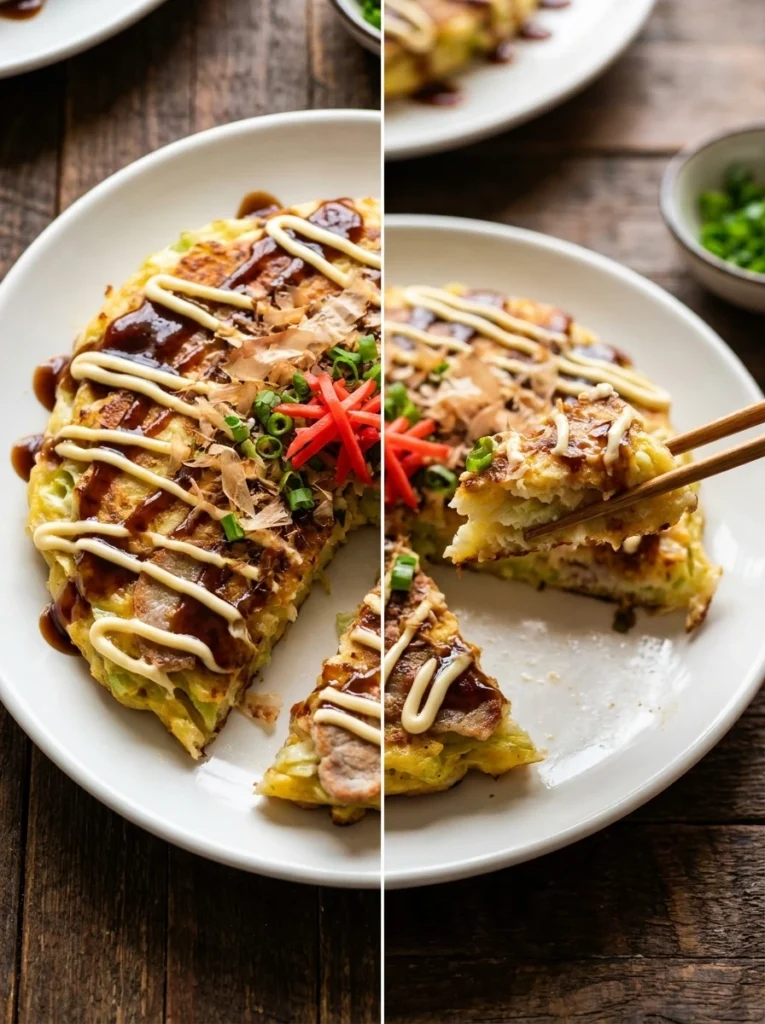
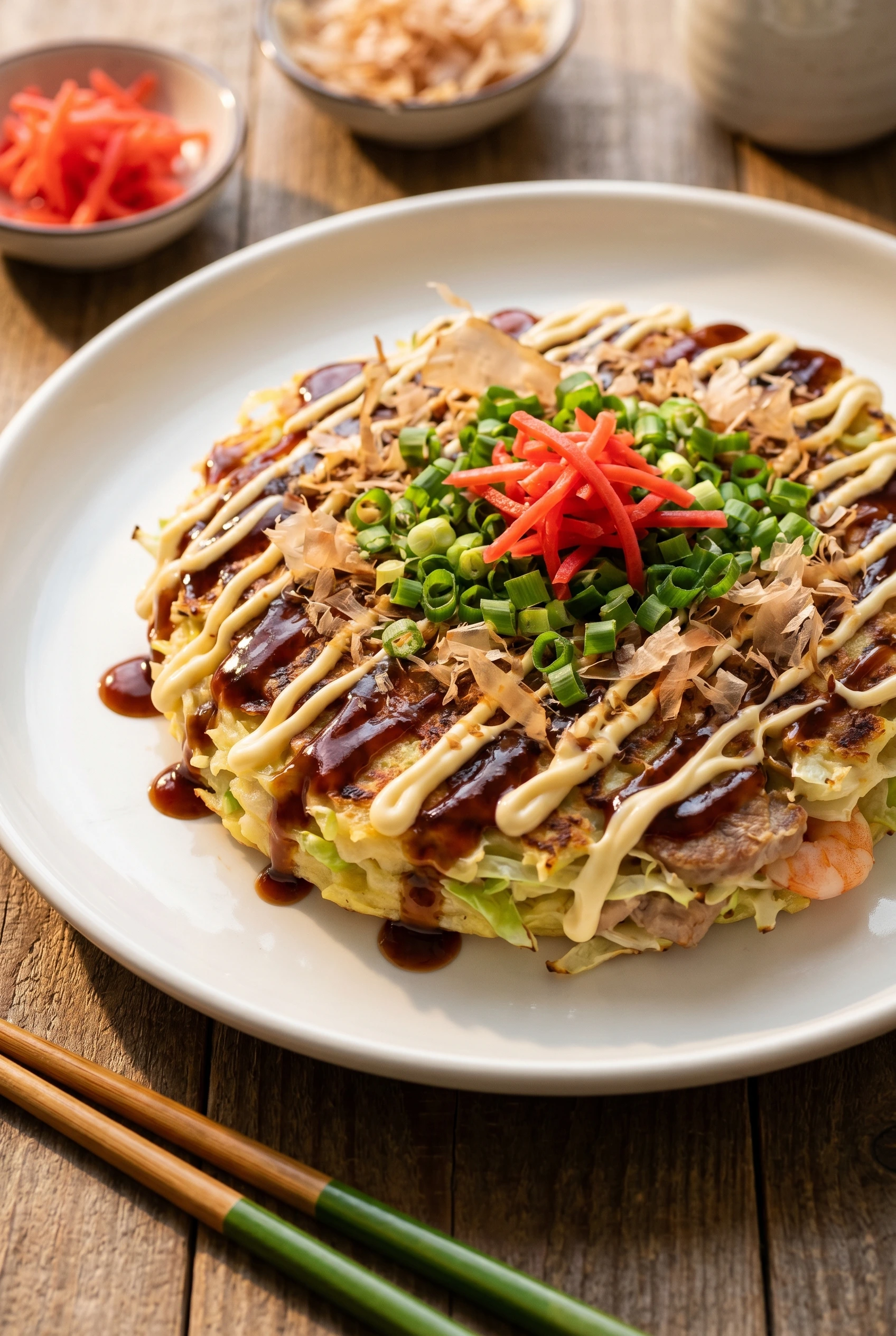
- Dress it up: Transfer to a plate, brush generously with okonomiyaki sauce, squirt mayo in a zigzag pattern, and shower it with bonito flakes and seaweed.
Seasoning and Taste as You Go
The batter carries mild flavor by design. The toppings deliver the full impact of the dish. Taste a small piece of the first pancake before committing to the topping quantities on subsequent ones:
- Too flat: Apply more okonomiyaki sauce across the surface and let it soak in for thirty seconds before eating.
- Too salty: Increase the Kewpie mayo and reduce the aonori quantity on the next pancake.
- Needs depth: Add one tablespoon of extra dashi to the remaining batter before cooking the next round.
♥ The Misfit Tips!
- Chop the cabbage with a knife, not a food processor. A food processor produces long, stringy shreds that tangle through the batter and cause the pancake to tear apart at the seam during flipping. Small, uniform knife-cut squares distribute evenly and hold together through the entire cook.
- Wear gloves when grating nagaimo. The raw yam causes persistent skin irritation from the oxalic acid crystals in its surface. Bare hands in contact with grated nagaimo itch for hours regardless of how thoroughly they get washed afterward.
- Wait for the full crust before flipping. Attempting the flip before the bottom sets into a firm crust produces fragments rather than a pancake. Five full minutes on medium heat with the lid on builds enough structure to support the flip every time.
Make It Yours
- Chop the cabbage with a knife, not a food processor. A food processor produces long, stringy shreds that tangle through the batter and cause the pancake to tear apart at the seam during flipping. Small, uniform knife-cut squares distribute evenly and hold together through the entire cook.
- Wear gloves when grating nagaimo. The raw yam causes persistent skin irritation from the oxalic acid crystals in its surface. Bare hands in contact with grated nagaimo itch for hours regardless of how thoroughly they get washed afterward.
- Wait for the full crust before flipping. Attempting the flip before the bottom sets into a firm crust produces fragments rather than a pancake. Five full minutes on medium heat with the lid on builds enough structure to support the flip every time.
Perfect Pairings
This okonomiyaki works best alongside two things that cut through the richness of the pork belly and Kewpie mayo:
- A crisp cucumber salad dressed with rice vinegar and a pinch of sugar that provides acid contrast against the savory batter
- A cold, dry Japanese lager or sparkling water with yuzu that cleans the palate between bites
How to Store Okonomiyaki
❤
- Fridge. Up to 3 days, wrapped tightly in foil without any sauce or mayo applied. The pancakes lose their crisp edges but reheat well in the oven.
- Freezer. Up to 1 month, unsauced, wrapped individually in plastic wrap then foil. Thaw overnight in the refrigerator before reheating.
- Reheat. Bake at 350°F for 10 minutes on a wire rack set over a baking sheet. Microwaving produces a rubbery, steamed texture rather than a crisp one.
- Toppings. Apply the sauce, mayo, bonito flakes, and aonori immediately before eating, never before storing. Pre-sauced pancakes turn into soggy sponges in the refrigerator overnight.
Okonomiyaki
Ingredients
Equipment
Method
- Mix the batter baseWhisk the flour, grated nagaimo, and dashi together in a large bowl until smooth. Cover and refrigerate for at least 1 hour. Resting relaxes the gluten in the flour and produces a lighter, fluffier pancake. Skipping the rest produces a slightly denser result, which still tastes good but doesn't reach the airy texture of a properly rested batter.
- Prep and dry the cabbageChop the cabbage into small, uniform pieces roughly half an inch square. Spin it completely dry in a salad spinner or press it between two clean kitchen towels. Wet cabbage turns the batter liquid during cooking and prevents the pancake from setting firmly enough to flip.
- Combine the full batterAdd the eggs, tempura scraps, and dried cabbage to the rested base. Fold gently with a spatula until the cabbage coats evenly in batter. Overmixing develops the gluten further and produces a tough, dense pancake.
- Cook the first sideHeat a thin layer of neutral oil in a large nonstick skillet over medium heat. Pour in enough batter to form a circle about one inch thick. Lay the pork belly slices across the top in a single layer. Cover the pan with a lid and cook for 5 minutes until the edges look set and the bottom releases cleanly from the pan.
- Execute the flipSlide one spatula under the center of the pancake. Place the second spatula flat on top of the pancake. Flip quickly in one confident motion. A slow, hesitant flip produces a broken pancake. A broken pancake pressed back together with the spatula cooks identically to an intact one.
- Finish cookingCover the pan and cook the pork belly side for 5 more minutes. Remove the lid and cook for an additional 2 minutes to crisp the edges.
- Dress and serveTransfer to a plate with the pork belly side facing up. Brush the surface generously with okonomiyaki sauce. Squeeze Kewpie mayo across the top in a zigzag pattern. Scatter bonito flakes and aonori over everything and serve immediately before the flakes stop moving.