
Staring at a half-empty jar of instant espresso powder at six in the morning, deeply resenting the fact of being awake, is exactly what led to this chocolate espresso coffee cake. Caffeine felt necessary, but cake felt equally necessary, since adulthood sometimes requires heavy coping mechanisms.
A previous attempt at a zebra-striped cake for a bake sale once looked like a muddy swamp, but this batter stays thick enough to hold its stripes properly. This espresso coffee cake recipe delivers a breakfast that aggressively wakes anyone up while validating a serious sweet tooth. Here is exactly how I do it.
Why You’ll Love This Recipe
- Double duty. This is breakfast and morning coffee rolled into one aggressive slice.
- Looks fancy. Zebra stripes make anyone look like a baking wizard, even in sweatpants worn inside out.
- Texture magic. Reverse creaming makes the crumb ridiculously tender, which is just a fancy way of saying it will not dry out by Tuesday.
- Crowd-pleasing. This passes as an acceptable morning meeting snack but tastes like a decadent chocolate coffee cake.
Tools You’ll Need
Nothing fancy, I promise.
- 8-inch square baking pan – If you only have a 9-inch round, that works too, just watch the bake time.
- Two mixing bowls. These handle the two different colored batters separately.
- Whisk. This keeps the glaze free of powdered sugar clumps.
Ingredients
For the Crumb Topping
- 1/2 cup all-purpose flour – Measure this correctly or you get rocks instead of crumbs.
- 1/4 cup brown sugar – Pack it in there.
- 1 tsp cinnamon – Balances out the deep coffee flavor.
- 1/4 cup unsalted butter – Melted, because cutting in cold butter is exhausting.
For the Cake Batter
- 1.5 cups all-purpose flour – The base of our espresso crumb cake.
- 1 cup granulated sugar – Standard sweet stuff.
- 1/2 cup unsalted butter – Softened, and I mean actually soft, not microwaved into a puddle.
- 2 large eggs – Room temperature if you remember, straight from the fridge if you are me.
- 1/2 cup whole milk – Keeps things tender.
- 2 tsp vanilla extract – The good stuff if you have it.
- 1 tbsp instant espresso powder – The star of the show.
- 2 tbsp black cocoa powder – Or regular Dutch-processed if you can’t find black cocoa (read up on Dutch-process chocolate if you are a nerd).
For the Glaze
- 1 cup powdered sugar – Sift it if you have the patience.
- 2 tbsp brewed espresso – Strong coffee works too.
How To Make Espresso Coffee Cake
Turn on your oven and prepare to make your kitchen smell better than a fancy café.
- Prep the oven: Preheat to 350°F and grease your baking pan. If you forget to grease it, you will be eating this chocolate espresso crumb cake directly out of the pan with a spoon, which I have done and highly recommend.
- Make the crumbs: In a small bowl, mix the flour, brown sugar, cinnamon, and melted butter until clumps form. If you eat half the crumbs before they make it onto the cake, that is between you and the mixing bowl, nobody else needs to know.
- Mix the base batter: Beat the flour, sugar, butter, eggs, milk, and vanilla until smooth using the reverse creaming method. This just means mixing dry ingredients with butter first—if it looks like wet sand initially, do not panic, it will come together.
- Divide and flavor: Split the batter in half; leave one plain vanilla, and mix the espresso powder and black cocoa into the other half. It will look alarmingly dark, but that is exactly what you want for that striking zebra contrast.
- Layer the stripes: Alternate dollops of vanilla and chocolate-espresso batter in your pan, then swirl gently with a knife. Do not over-swirl or you will just have a light brown blob instead of cool stripes.
- Top and bake: Sprinkle the crumb topping evenly over the batter and bake for 45 to 50 minutes. A toothpick should come out clean—if it comes out gooey, put it back in and stop being impatient.
- Glaze it: Whisk the powdered sugar and brewed espresso, then drizzle over the cooled cake. If you drizzle it while the cake is hot, the glaze will melt into an invisible sticky puddle, which tastes fine but looks sad.
♥ The Misfit Tips!
- Never rush the cooling. Glazing this while practically smoking out of the oven once caused the glaze to melt completely and vanish.
- Respect the espresso powder. Regular ground coffee beans leave behind gritty grounds instead of dissolving smoothly like instant espresso powder.
- Trust the reverse creaming trick. Mixing butter into flour first feels wrong at first, but it coats the flour in fat and keeps the cake tender.
Perfect Pairings
This mocha crumb cake suits two specific pairings particularly well.
- A cold glass of milk washes down the intense mocha crumb topping.
- Sunday brunch with the in-laws looks impressive enough to distract from a messy house.
Make it yours
- Nutty version. You fold chopped hazelnuts into the crumb topping for extra crunch.
- Mocha chip version. You fold mini chocolate chips into the chocolate espresso batter half for extra richness.
How to Store Espresso Coffee Cake
❤
- Fridge. Up to five days in an airtight container, though the crumb dries out slightly.
- Freezer. Up to two months wrapped tightly in plastic wrap, thawed on the counter overnight.
- Reheat. Ten seconds in the microwave brings back a freshly baked taste.
- Storage note. The coffee glaze can get sticky in humid environments, so covering it with a dome rather than flat plastic wrap keeps it neat.
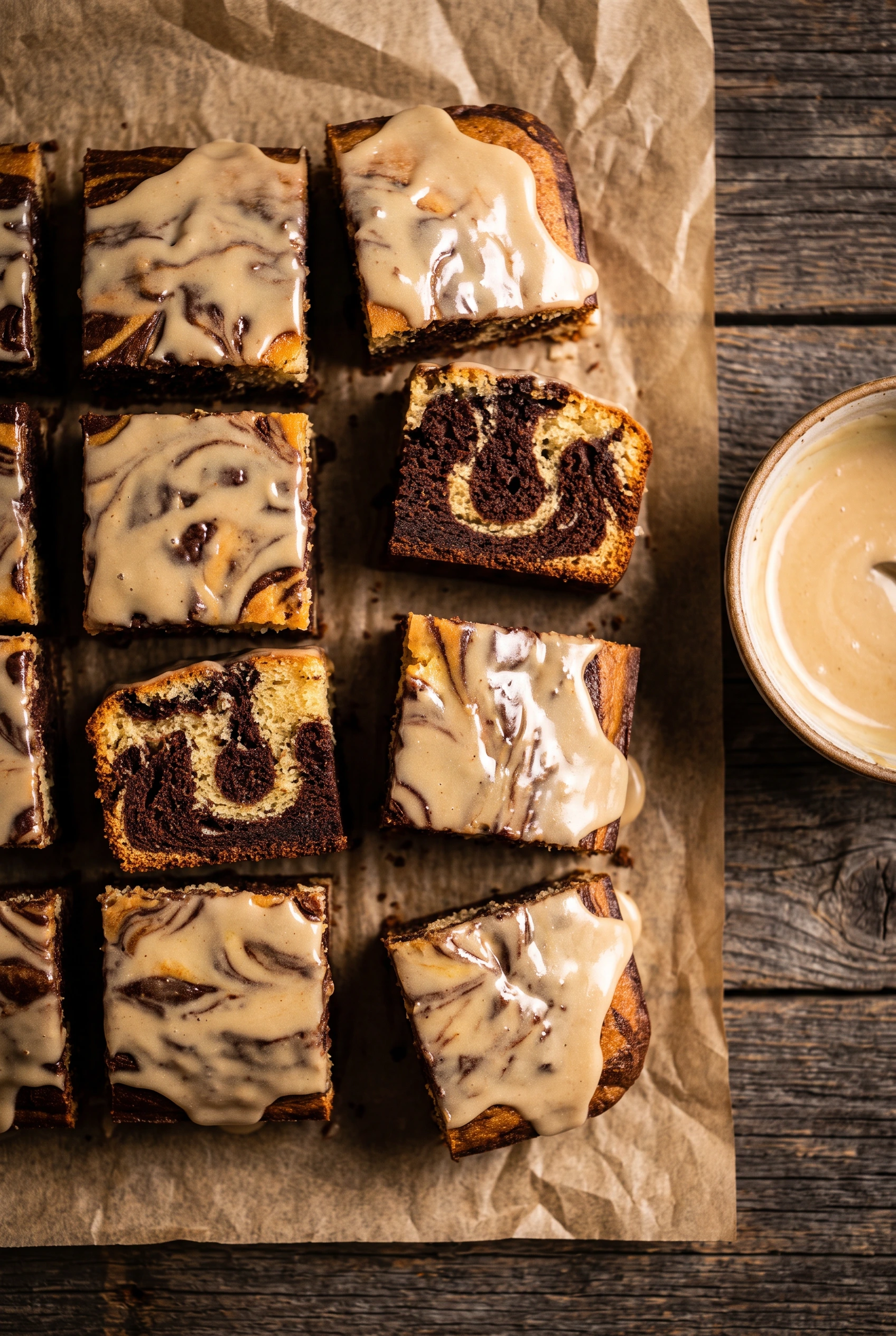
Glazed Espresso Coffee Cake
Ingredients
Equipment
Method
- Preheat the oven to 350°F. Prepare an 8″ square pan with a parchment sling or reusable silicone liner, then lightly grease the sides of the pan. Alternatively, line a 9″ cake pan with a round piece of parchment or round reusable liner and lightly grease the sides.
- To make the crumbs: Weigh your flour; or measure it by gently spooning it into a cup, then sweeping off any excess. In a medium bowl, whisk together the flour, sugars, cinnamon, salt, and espresso powder. Add the butter and vanilla; toss to combine. Using a bowl scraper, fork, or your fingers, work in the butter until crumbs form and no dry spots remain. The crumbs should be irregular, ranging in size from a pea to walnut. Set aside.
- To make the cake: In a large bowl or bowl of a stand mixer, combine the flour, sugar, baking powder, salt, and baking soda. Add the butter and mix at low speed using an electric hand mixer or the flat beater attachment of a stand mixer until the mixture looks sandy, about 1 to 2 minutes. (This mixing method is called reverse creaming and is also known as the paste method.)
- Beat in the vanilla and eggs, then mix until no dry spots of flour remain. Stop the mixer and scrape the bowl and beater attachment as needed; the mixture will be thick.
- Combine the buttermilk and 1/2 cup (113g) of the coffee or cold brew concentrate. Keep the mixer running and slowly add the wet mixture to the bowl. Mix until smooth, then stop the mixer to scrape the bowl and mix again at medium-low speed for 1 minute; this final mix is key to ensuring the best texture so don’t skip it.
- To assemble and bake the coffee cake: In a medium microwave-safe bowl, combine the espresso powder, black cocoa, and the remaining 1 tablespoon of coffee or cold brew concentrate. Stir to combine. Heat briefly in the microwave if the mixture remains lumpy.
- Transfer slightly less than half, about 1 1/2 cups (375g), of batter to the medium bowl with the espresso/cocoa mixture. Stir until the batter is uniform in color with no dark streaks remaining; this will be the espresso batter. (The remaining batter is the vanilla batter.)
- Portion roughly 1/2 cup (about 100g) of the vanilla batter into the prepared pan (a scone or muffin scoop works well here; use 2 scoops for 1/2 cup). Next, use the same scoop to portion about 1/4 cup (approximately 50g) of the espresso batter into the center of the vanilla batter and gently spread it in a small circle using the back of the scoop. (This will cause the vanilla batter to spread.) Continue to scoop the batters, alternating between espresso and vanilla, in 1/4 cup increments (like you’re creating a bull’s eye pattern) until all the batter is used. You will now have thin rings of each batter towards the edges of the pan and thicker rings towards the center.
- Sprinkle the crumbs evenly over the batter and gently press to adhere.
- Bake the coffee cake for about 45 to 50 minutes, until it’s set in the middle and lightly browned. (Check for doneness after 45 minutes and add additional time only as needed to avoid overbaking the coffee cake.) When the cake is done, a toothpick or paring knife inserted into the center should come out mostly clean.
- Remove the coffee cake from the oven and allow it to cool in the pan for 20 minutes. Prepare the glaze while the coffee cake is cooling.
- To make the glaze: In a small bowl, stir together the glaze ingredients until smooth, starting with smaller amount of coffee or cold brew concentrate. Add additional liquid as needed until the glaze is the consistency of molasses.
- Remove the coffee cake from the pan using the overhanging edges of parchment as handles to gently lift it out. Place the coffee cake (still on the parchment) on a wire rack.
- Drizzle thick ribbons of glaze over the entire top of the cake; the goal is to completely cover the top with glaze, encrusting the crumbs with even more coffee flavor. For a sugar-crusted texture, allow the glaze to set before slicing the coffee cake (about 1 hour); serve at room temperature.
- Storage information: Store leftover coffee cake, well wrapped, at room temperature for several days; freeze for longer storage.